
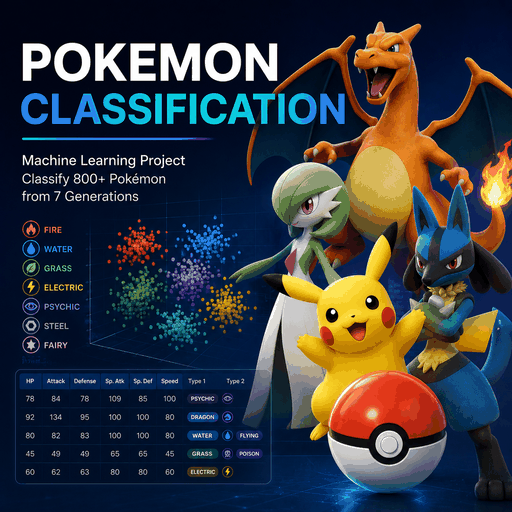
Machine Learning · KNN · 800 Pokémon · generations 1 to 6
Pokémon Classification with scikit-learn
Predict a Pokémon's primary type from its combat stats alone. A complete supervised classification pipeline, from exploration to evaluation, using the K-Nearest Neighbors algorithm.
PythonPandasNumPyMatplotlibSeabornscikit-learn
Free · No account·Intermediate·~1h
What you'll build
- ✓A complete classification experiment predicting a Pokémon's primary type from its statistics
- ✓An intuitive understanding of KNN through distance, neighborhoods and feature scale
- ✓An evaluation that goes beyond one overall score to investigate errors between types
- ✓A concrete demonstration of how class count and separability change problem difficulty
Lab walkthrough
01
Explore before predicting
Observe type distribution and check whether statistics naturally reveal distinct groups.
02
Frame the problem
Separate the information given to the model from the category it must learn to predict.
03
Prepare an honest evaluation
Separate training and test data while preserving representation of every type.
04
Understand the idea of a neighbor
Calculate a distance manually to see how KNN turns similarity into a prediction.
05
Make statistics comparable
Understand why feature scale affects distances and correct this bias.
06
Train and predict
Apply KNN reasoning to the training data and make predictions on unseen examples.
07
Question model performance
Analyze confusions, then simplify the problem to test the role of class count and profiles.
Expected results
~24 %
18 types (all)
~35 %
Top 5 types
~75 %
3 contrasted types (Rock / Flying / Water)
Skills covered
- · Supervised problem framing
- · Training and evaluation split
- · Distance and neighborhood reasoning
- · Feature scaling
- · Confusion matrix interpretation
- · Class separability analysis
Prerequisites
- · Python basics (functions, lists)
- · Basic Pandas (DataFrame)
- · No ML experience required
- · No installation : online lab